
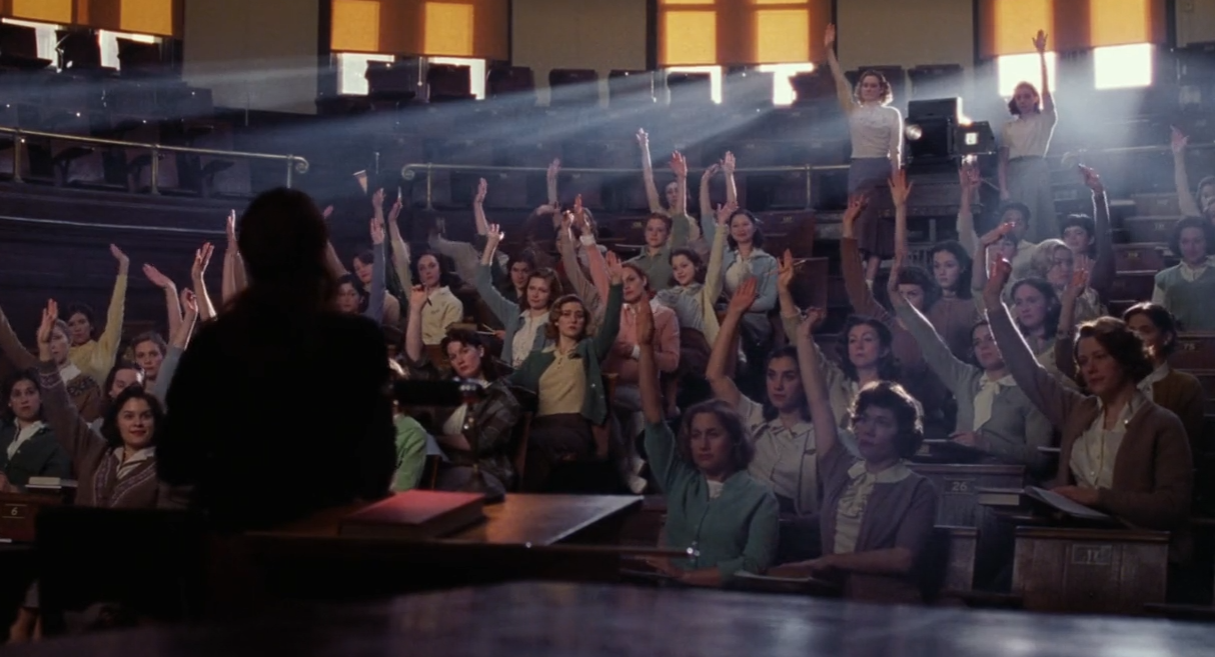
A classroom interaction between Katherine Ann Watson and her Art History class
[Slide flips to Carcass of Beef, ca. 1925, Chaïm Soutine]
Betty Warren
“What is that?”
Katherine Ann Watson
“You tell me. [pauses] Carcass by Soutine. 1925.”
Student
“It’s not on the syllabus.”
Katherine
“No, it’s not. [pauses] Is it any good?”
“Come on, ladies. There’s no wrong answer. There’s also no textbook telling you what to think. It’s not that easy, is it?”
Betty
“Alright, no. It’s not good. In fact, I wouldn’t even call it art. It’s grotesque.”
Connie Baker
“Is there a rule against art being grotesque?”
Gisele Levy
“I think there’s something aggressive about it… and erotic.”
Betty
“To you, everything is erotic.”
Gisele
“Everything is erotic.”
Katherine
“Girls.”
Student
“Aren’t there standards?”
Betty
“Of course, there are! Otherwise a tacky velvet painting could be equated to a Rembrandt.”
Connie
“Hey, my Uncle Ferdie has two tacky velvet paintings. He loves those clowns.”
Betty
”There are standards, technique, composition, colour, even subject. So, if you’re suggesting that rotted side of meat is art, much less good art, then what are we going to learn?”
Katherine
”Just that. You have outlined our new syllabus, Betty, Thank you. What is art? What makes it good or bad? And who decides? Next slide, please. Twenty-five years ago, someone thought this was brilliant.”
Connie
”I can see that.”
Betty
”Who?”
Katherine
”My mother. I painted it for her birthday. Next slide. This is my mom. Is it art?”
Student
“It’s a snapshot.”
Katherine
“If I told you Ansel Adams had taken it, would that make a difference?”
Betty
“Art isn’t art until someone says it is.”
Katherine
“It’s art!”
Betty
“The right people.”
Katherine
”Who are they?”
Julia
“Betty Waren. We’re so lucky we have one of them right here.”
Betty
“Screw you.”
Katherine
”Could you go back to the Soutine, please? Just look at it again. Look beyond the paint. Let us try and open our minds to a new idea. Alright, back to chapter three. Has anyone read it?”